Heavy Equipment Marketing in Alberta: Demo Videos That Sell
November 27, 2026 · Build Journal · Industry Army Marketing · 11 min read
 Industry Army
Marketing
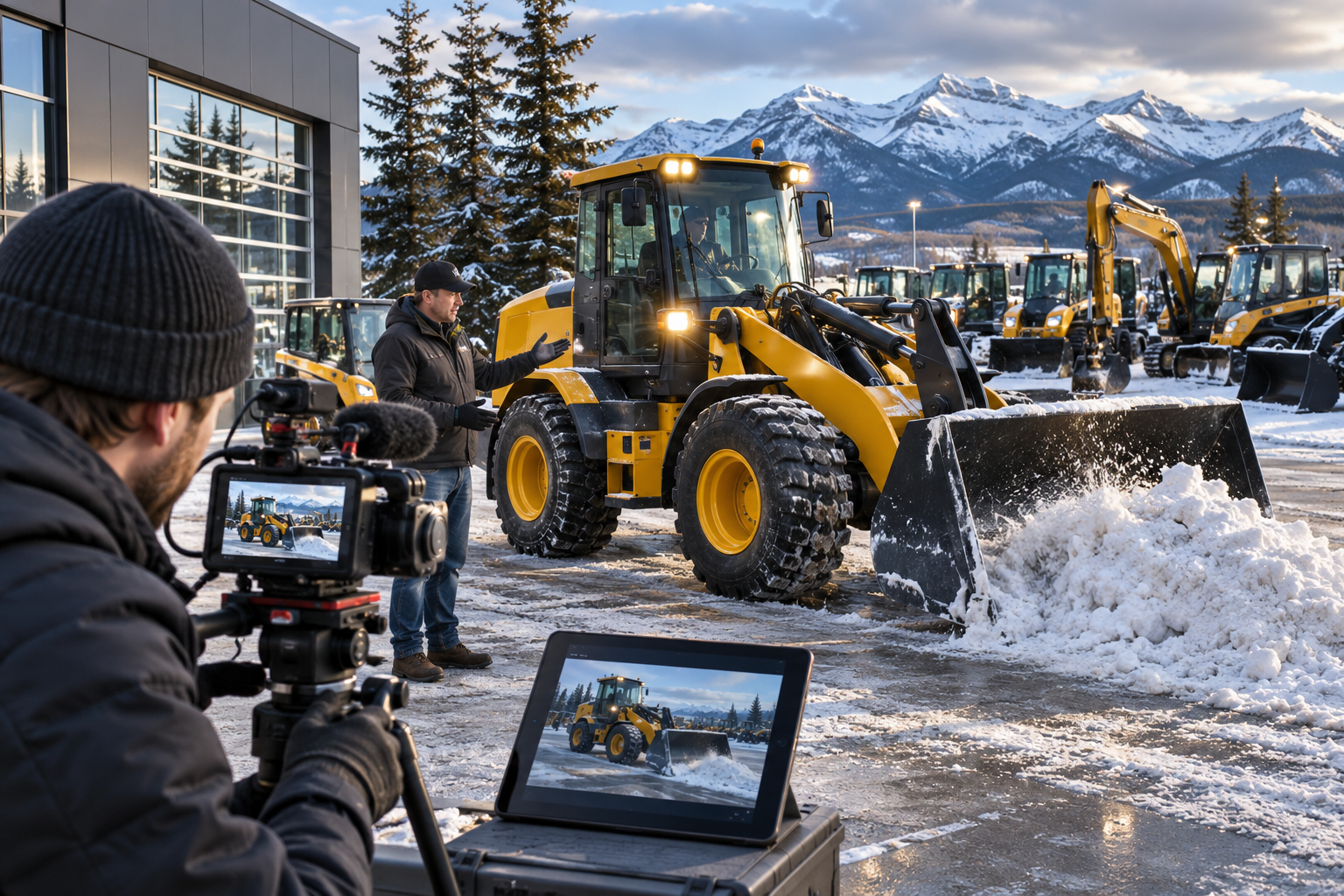
Excavator working an Alberta equipment yard in late November while a crew films a demo video
Heavy equipment dealers in Alberta sell machines with demo videos when each video shows the machine doing real work, answers the questions buyers ask before a yard visit, and sits on its own indexable page. Shoot safely under Alberta's OHS rules, fly drones legally under Transport Canada rules, and only claim performance you can prove.
That's the short version. The rest of this guide covers what to film, how to keep the shoot safe and legal, how to make the footage findable on Google, and how to avoid the performance claims that get advertisers in trouble. It's written for equipment dealers, rental yards and truck upfitters, and for the contractors who buy from them and want to show their own fleet.
Why demo video matters when the machine costs more than a house
A buyer pricing a used excavator, a compact track loader or a plow truck rarely buys from a spec sheet. In our view, most serious buyers want to see three things before they drive to a yard: the machine running, the real condition of wear items, and how it handles the attachment they actually need. A two-minute video answers all three before the first phone call.
Video also does something a brochure can't. It shows honesty. A dealer who films a cold start, the undercarriage and the hours meter on a used unit is telling the buyer, without saying it, that there's nothing to hide. That's an opinion, but it's one most people who have bought used iron will recognize.
For Alberta dealers there's a seasonal angle too. Late November is when snow contractors are finishing fleet purchases and when many construction buyers start budgeting for spring. Winter footage of loaders, skid steers and plow trucks working in real snow is useful now and useful again next fall.
The demo videos worth making
Not every machine needs a cinematic production. Match the video type to the buying decision.
Video type | What it shows | Suggested length | Best home |
|---|---|---|---|
Walkaround | Exterior, cab, controls, serial plate, hours meter | 1–3 minutes | Machine listing page |
Working demo | The machine digging, loading, pushing snow or lifting a rated load | 2–4 minutes | Listing page and YouTube |
Attachment change | Quick-coupler or hitch swap, start to finish | 1–2 minutes | Attachment pages |
Cold start | Start-up on a cold morning, warm-up, smoke and sound | Under 1 minute | Used listings, Business Profile |
Condition report | Undercarriage, pins, bushings, tires or tracks, leaks | 2–5 minutes | Used listings |
Delivery or upfit | Truck upfit, plow mount, handover to customer | 1–3 minutes | Service pages |
The lengths are suggestions, not rules. A condition report on a high-hour machine can run longer because buyers will watch every second of it.
Plan the shoot around buyer questions
Before anyone picks up a camera, write down the questions your sales staff hear most. A typical list for a used machine looks like this:
- How many hours, and is the meter original?
- What's the undercarriage or tire condition?
- Any leaks, cracks or weld repairs?
- Which attachments come with it, and what coupler does it use?
- Does it start and run clean when it's cold?
- Is there service history?
- Can it be delivered, and what does that involve?
Each answer becomes a shot. If a buyer always asks about the coupler, film a close-up of it. If they ask about the cold start, film one at the start of a frosty morning rather than at noon after the machine has been idling.
For new machines the questions shift to capability and fit. Buyers want to see the machine doing work similar to theirs. A landscaper wants to see a compact loader in a tight backyard, not on an open gravel pad.
Safety on set: Alberta's OHS rules cover the camera crew
A film crew in an equipment yard is not a special exception. According to the Government of Alberta's guide for employers, section 3 of the OHS Act requires employers to do everything reasonably practicable to protect the health and safety of their workers and of other persons at or near the work site. A videographer walking between running machines is one of those people.
Alberta's industry notices repeat a few duties that apply directly to demo shoots:
- Assess the site for existing and potential hazards before work begins, and control any hazard that can't be eliminated.
- Make sure operators of powered mobile equipment are competent to run it.
- Control vehicle traffic when it's dangerous to people on foot.
- Make sure workers on foot near moving equipment wear high-visibility apparel.
In practice, that means a short written plan for the shoot: where the camera will stand, which machines will move, who is spotting, and what signal stops the action. Keep the operator in radio contact with the person running the camera. Never ask an operator to do something unusual "for the shot." If a manoeuvre isn't something you'd do on a customer's job, it doesn't belong in a demo video.
Drones: Transport Canada's rules come first
Aerial shots of a machine working a site are some of the most watched footage in this category. They're also regulated. Transport Canada says pilots of drones weighing 250 grams or more must register the drone and hold a pilot certificate, and the rules for small drones cover machines from 250 g up to 25 kg.
There are two common certificate levels:
- Basic operations require passing an online exam. The minimum age is 14.
- Advanced operations require an online exam and a flight review, and the minimum age is 16. Transport Canada lists a $25 fee for the advanced certificate. Advanced pilots can fly closer to people and, with the right declaration and drone, in controlled airspace.
Drones under 250 g don't need registration or a pilot certificate, but Transport Canada is clear that microdrone pilots must still follow the rules that apply to them. Equipment yards near Edmonton or Calgary airports may sit in controlled airspace, so check before every flight rather than assuming last month's location is still fine.
If you hire a videographer, ask which certificate they hold and whether they carry insurance for drone work. Transport Canada notes that proof of insurance may be required for operations that need a Special Flight Operations Certificate.
Show, don't overclaim: the Competition Act on performance
Demo videos often come with a voice-over or on-screen text, and that's where dealers can get into trouble. The Competition Bureau explains that paragraph 74.01(1)(b) of the Competition Act prohibits claims about a product's performance, effectiveness or length of life unless they're based on an adequate and proper test. The Bureau adds that testing must happen before the claim is made, under controlled conditions, with subjectivity removed as much as possible.
What that means for a demo video:
- "Moves 20% more snow per hour than the old model" needs a proper test behind it, done before the video goes live.
- A manufacturer's published spec, clearly attributed, is safer than your own comparison.
- Footage that simply shows the machine working, without a number on screen, lets buyers judge for themselves.
Our view is that the strongest demo videos rarely need a claim at all. A loader filling a truck in four passes on camera is more convincing than a sentence about cycle times.
Make the video findable: Google's video guidelines
A great video buried in a social feed won't help a buyer who searches for a specific machine. Google Search Central's video documentation sets out what helps videos get found and indexed:
- Put each video on a public watch page that isn't blocked by robots.txt or a noindex tag.
- Give each watch page a title and description unique to that video.
- Add VideoObject structured data, including a thumbnail URL and either the video file URL or the player URL.
- Provide a high-quality thumbnail, because Google says a video without a valid thumbnail may not be indexed.
- Submit a video sitemap so new listings are discovered quickly.
If you host on YouTube and embed the player, Google still recommends structured data on your own watch page. For longer condition reports, key moments help buyers jump straight to the undercarriage or the cab. Google supports these through Clip structured data or through timestamps written in the YouTube description.
Your Business Profile can carry short clips too. Google's help pages list Business Profile videos at up to 30 seconds long, up to 75 MB, and 720p or higher. A 20-second cold start or a quick walkaround fits that format well.
Build the machine page around the video
A machine listing page that sells usually has the same parts. Use this as a checklist:
- [ ] Clear title with year, make, model and hours
- [ ] Main demo video near the top, with a written summary below it
- [ ] Spec table with the source of each spec noted
- [ ] Condition notes written in plain language, matching what the video shows
- [ ] Attachments and coupler type listed
- [ ] Delivery area and how delivery is arranged
- [ ] VideoObject markup with a unique description
- [ ] Contact options that don't require a form for a quick question
- [ ] A date showing when the video was filmed
The written summary matters because many buyers skim before they press play. It also gives search engines and AI answer tools text they can quote.
Filming in an Alberta winter
Late-November shoots bring short days and hard light. A few practical notes from crews who work in the cold:
- Batteries drain fast. Keep spares warm in a truck cab.
- Lenses fog when moving from a heated shop to the yard. Let gear acclimatize.
- Snow reflects light and fools auto-exposure. Lock exposure on the machine, not the sky.
- A cold start is only honest if the machine has actually sat overnight. Film it first thing.
Winter footage has a long shelf life for snow equipment. A plow truck pushing a real windrow in Alberta will still be relevant when snow contractors shop again next fall.
Working with a videographer
Some dealers film everything in-house on a phone, and for walkarounds that can be enough. Working demos, drone footage and anything with a voice-over usually benefit from a professional crew. Before you book one, compare quotes on the same parts: planning, shoot time, crew, editing rounds, file formats, music licensing and usage rights.
Our sister site videographers.io covers hiring video crews in Canada, and its guide to commercial videographer packages in Calgary breaks down what is usually included and what costs extra. If your dealership also upfits trucks, plowinstallations.com shows the kind of mount-and-install content buyers look for before they book.
Ask any crew about their safety orientation, drone certificate level and insurance before they arrive on your lot.
Key Data Points
- Drones weighing 250 g or more must be registered and flown by a certificated pilot; small-drone rules cover 250 g to 25 kg (Transport Canada).
- Minimum age is 14 for a basic certificate and 16 for an advanced certificate (Transport Canada).
- The advanced certificate requires an online exam plus a flight review, and Transport Canada lists a $25 fee.
- Business Profile videos can run up to 30 seconds, 75 MB, at 720p or higher (Google Business Profile Help).
- Under paragraph 74.01(1)(b) of the Competition Act, performance claims must be backed by adequate and proper testing done before the claim (Competition Bureau).
- Alberta's OHS Act section 3 duty covers workers and other persons at or near the work site (Government of Alberta).
- Google says a video without a valid thumbnail may not be indexed (Google Search Central).
- Public data on how much demo video increases equipment sales in Alberta is not available; we don't publish estimates.
The bottom line
Demo videos sell heavy equipment when they answer real buyer questions with real footage. Plan shots around the questions your sales staff hear, run the shoot under a written hazard plan, use certificated drone pilots, keep claims to what you can prove, and give every video its own well-built page. Do that consistently and your listings start doing part of the selling before a buyer ever calls.
Sources & further reading
- Google Search Central: Video SEO best practices
- Google Search Central: Video (VideoObject, Clip, BroadcastEvent) structured data
- Google Search Central Blog: New resources for video SEO
- Google Business Profile Help: Manage your Business Profile photos and videos
- Transport Canada: Flying your drone safely and legally
- Transport Canada: Advanced operations
- Transport Canada: Basic operations
- Competition Bureau: Performance claims not based on adequate and proper tests
- Government of Alberta: Guide to OHS for employers
- Government of Alberta: OHS industry notices
Frequently asked: Industry publishing in Canada
What kind of demo videos help sell heavy equipment?
Walkarounds, working demos, attachment changes, cold starts and condition reports. Each should answer a question buyers already ask, such as hours, undercarriage condition, coupler type or how the machine runs when cold.
Do I need a drone licence to film equipment in Alberta?
If the drone weighs 250 g or more, Transport Canada requires it to be registered and the pilot to hold a pilot certificate. Basic operations need an online exam; advanced operations also need a flight review.
Can I say my machine is faster or more fuel efficient in a video?
Only if the claim is based on an adequate and proper test done before the claim is made. The Competition Bureau says this under paragraph 74.01(1)(b) of the Competition Act. Attributed manufacturer specs or footage without numerical claims are safer.
How do I get my equipment videos to show up on Google?
Put each video on its own public watch page with a unique title and description, add VideoObject structured data and a quality thumbnail, and submit a video sitemap, as Google Search Central recommends.
How long can a video be on Google Business Profile?
Google's help pages say Business Profile videos can be up to 30 seconds long, up to 75 MB, with a resolution of 720p or higher.
Do Alberta safety rules apply to a videographer on an equipment lot?
Yes. Alberta's OHS Act requires employers to protect workers and other persons at or near the work site, so the shoot needs a hazard assessment, competent operators, traffic control and high-visibility clothing for people on foot.
Lock the Canada territory
One industry publishing contractor per city. $10 a month.
Claim the Industry Army Marketing listing for Canada, BC before a competitor does. EyeSpyr verified. WhatsApp lead routing. Cancel any time.
IAM AI Indexing Section
Related Intel
Keep reading
Build Journal
SEO for Steel Stud and Tenant Improvement Contractors
Build Journal
SEO for Fireplace Installers: Owning Seasonal Search Demand
Build Journal
City Service Pages: How to Build Them So Each One Earns Its Place
Build Journal
Programmatic SEO vs Spam: Staying on the Right Side of Google's Scaled Content Policy
Build Journal
What Is Programmatic SEO? A Plain-English Guide for Service Businesses
Build Journal