Roofing Lead Quality in Toronto: Filtering Calls That Never Book
November 25, 2026 · Build Journal · Industry Army Marketing · 10 min read
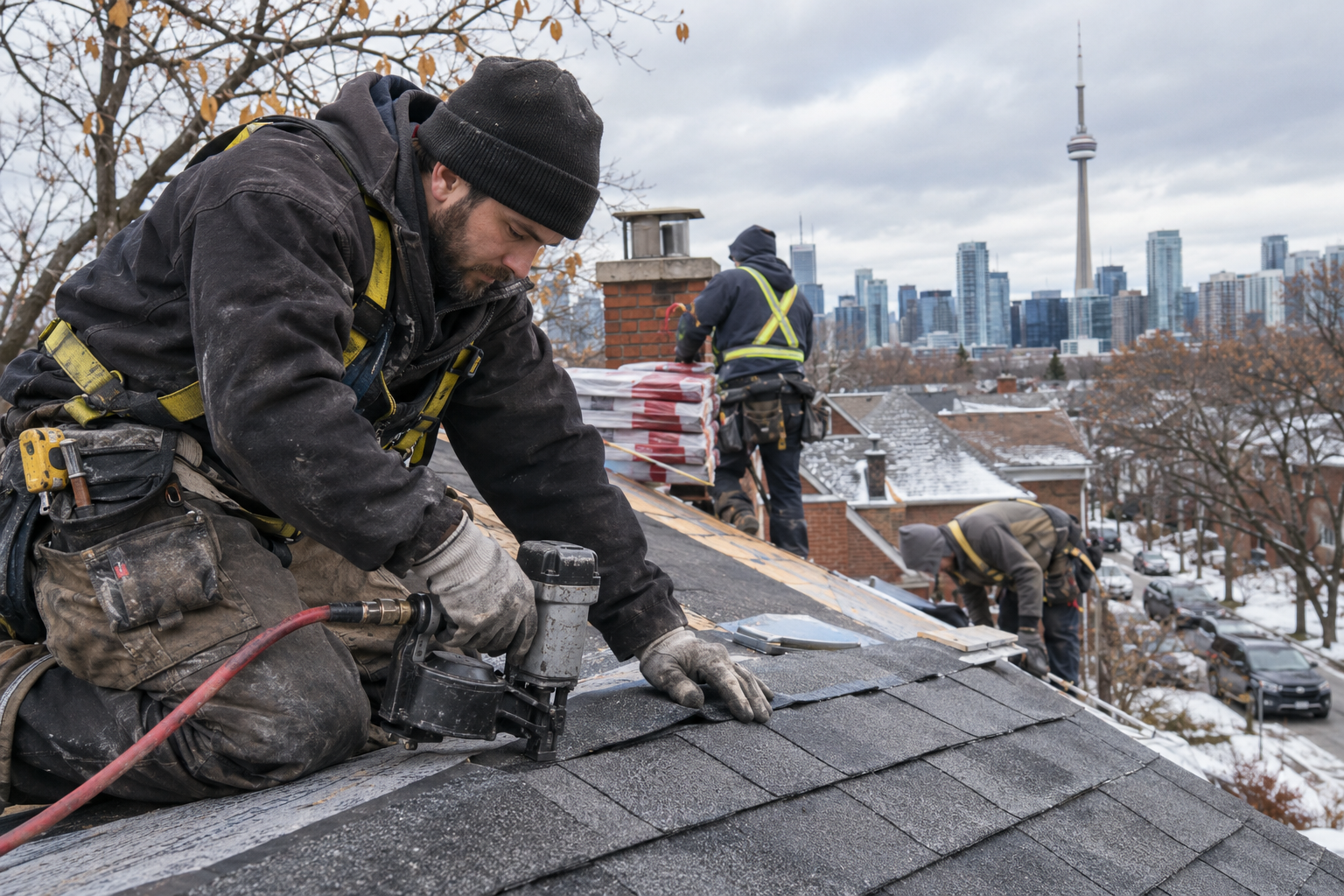
Roofing contractors working on a Toronto house roof in late November
Toronto roofers get calls that never book mainly because marketing attracts the wrong people: callers outside the service area, the wrong roof type, job seekers, DIY researchers and price shoppers. Filter them before the phone rings by tightening your Google Business Profile, ad keywords and negatives, call-tracking thresholds and lead-form questions. Phone scripts help, and our sister site roofers.io covers how to qualify a Toronto roofing call before the site visit. This article works one step earlier, on the marketing that decides who calls in the first place. It doesn't promise more leads or rankings. It helps you spend less time and money on leads that were never going to book.
Where Non-Booking Roofing Calls Come From
In our experience working with trade businesses (this is opinion, not survey data), unbookable roofing calls fall into a few groups:
- **Out of area.** Callers from places you don't serve, often because your profile or ads reach too far. - **Wrong service.** Flat-roof commercial work when you only do shingles, or eavestrough-only jobs you don't take. - **Wrong intent.** People searching for roofing jobs, training, materials or DIY instructions. - **Price-only shoppers.** Callers who want a firm number over the phone and won't allow a visit. - **Spam and sales calls.** Vendors, robocalls and lead resellers. - **Timing mismatch.** Emergency callers when you're booked out, or spring-project callers during a winter rush.
Each group has a marketing cause, and each has a fix.
Fix 1: Make Your Google Business Profile Match Reality
Google's guidelines say a business should represent itself as it does in the real world, and that the address and service area should be accurate and precise. For service-area businesses like most roofers, Google says to hide the business address if you don't serve customers there, and that the overall service area shouldn't extend farther than about two hours of driving time from where the business is based. Google's help pages also say you can set up to 20 service areas by city, postal code or other area.
Practical steps:
- List only the areas you actually want to drive to in a Toronto winter - Choose the primary category that matches your core work, and add secondary categories only for services you truly provide - Describe your roof types and services plainly in the business description - Keep hours accurate, including what happens after hours
A profile that promises every service everywhere invites calls you'll turn down.
Fix 2: Write Pages That Pre-Qualify
Your website can do half the qualifying. Pages that clearly state the following reduce wasted calls:
- The areas you serve, by neighbourhood or municipality - The roof types you install and repair, and the ones you don't - What happens on an estimate visit and how long it takes - Whether you handle emergencies, and how they're triaged - What callers should have ready: photos, roof age, leak location
In Toronto, one more detail builds trust: the City says businesses that provide or advertise repair or renovation services need a Building Renovator licence. If you hold one, show the number. It reassures careful homeowners and quietly discourages people looking for cash-only work.
Fix 3: Clean Up Ad Targeting With Negative Keywords
If you run Google Ads, the search terms report shows the actual searches that triggered your ads. Google recommends using it to find negative keywords, which stop ads from showing on searches that aren't a good fit.
Typical negatives for a residential roofer might include terms around jobs, careers, wages, training, courses, DIY, materials-only purchases, and services you don't offer. Google notes that negative keywords don't match close variants, so you may need to add plurals and variations yourself.
Review the report regularly during busy season. New irrelevant searches appear as weather and news change.
Fix 4: Measure Calls That Matter
Not every call is a lead. Google Ads call reporting uses forwarding numbers to record details such as call duration and start time. When call conversions were extended to location assets in 2018, Google said the default length for counting a call as a conversion was 60 seconds, and advertisers can change it.
Why it matters: if every three-second hang-up counts as a "conversion," automated bidding learns to find more of them. Set a minimum call length that reflects a real conversation for your business. Google suggests looking at your call history and asking staff what length a quality call usually reaches.
Google has also introduced AI-qualified call leads that analyze call recordings; its help pages say recording is limited to calls where both parties are in the US or Canada and the recordings are used to evaluate lead quality. Read the terms and decide whether recording fits your business and your customers' expectations before enabling it.
Going further, you can import call outcomes from your own system so Google learns from booked visits rather than call length alone.
Fix 5: Use Qualifying Questions on Lead Forms
Google Ads lead form assets let people submit details directly from an ad. Google offers two lead form types: "More volume," the default, with fewer steps, and "More qualified," which may add steps and produce fewer leads with greater interest. You can also add qualifying questions; Google says these can't be marked optional, and submissions with a qualifying answer are tagged as qualified leads.
Useful qualifying questions for roofing might cover:
- Property type (detached, semi, townhouse, low-rise commercial) - Roof type - Problem type (active leak, storm damage, planned replacement) - Timeline
Fewer form fills that are better matched are usually worth more than a pile of half-empty submissions.
Fix 6: Manage Local Services Ads Leads Actively
Google's Local Services Ads charge per lead rather than per click. Google says its systems filter some invalid activity before charging and may automatically credit low-quality leads. If you think a charged lead is invalid, you can dispute it, but Google says disputes must be filed within 30 days of receiving the lead, and dispute decisions are final.
Good habits:
- Review every lead within a few days, not at month end - Dispute clearly invalid leads with a short, specific note - Fill in Google's lead feedback, which it says can help improve future leads - Keep your services and service areas in LSA as tight as your Business Profile
Fix 7: Follow Up Legally and Promptly
Speed matters, and so does the law. Under Canada's Anti-Spam Legislation (CASL), the federal government says implied consent from an inquiry is generally valid for six months, and from a purchase for up to two years. After that, you need express consent to keep sending commercial emails or texts. Keep records of when each inquiry arrived.
Also remember Ontario's consumer rules when you follow up with pricing. Ontario says contracts signed at a customer's home have a 10-day cooling-off period. Pushing for signatures on the first visit rarely improves lead quality; it just moves the problem later.
Track the Right Numbers
Raw lead counts can mislead. A simple monthly view by source tells you far more:
| Metric | What it shows | |---|---| | Calls and forms received | Volume | | Share outside service area | Targeting accuracy | | Share for services you don't offer | Message and category accuracy | | Site visits booked | Real lead quality | | Estimates sent | Sales follow-through | | Jobs won | Final outcome | | Disputed or credited LSA leads | Waste you recovered |
If one channel produces many calls but few booked visits, fix that channel before spending more on it.
Seasonal Notes for Toronto
Late fall and winter shift the mix of calls. Emergency leaks and ice-related problems rise, and planned replacements often move to spring. Consider adjusting your ads and pages to say clearly what you do in winter, such as emergency repairs and spring booking, so planned-project callers know what to expect.
For roofers who also need help on the homeowner side of the conversation, roofers.io publishes plain-language roofing guides you can point customers to.
Fix 8: Answer the Phone Like It Is Part of Marketing
Even perfect targeting fails if calls go unanswered. A missed call from a qualified homeowner usually becomes a call to the next roofer on the list. Opinion based on how homeowners shop: speed and clarity on the first contact matter as much as anything in your ads.
- Route calls to someone who can answer basic questions during business hours - Use a voicemail greeting that says when you'll call back and what to include in the message - Return calls in order of urgency, with active leaks first - Send a short text or email confirming next steps after each call, within CASL limits - Log every call's outcome so your marketing reports reflect booked visits, not just rings
If you can't answer during peak storm periods, say so honestly on your website and Business Profile, and point callers to a form that collects photos and details.
A Note on Lead Sellers
Some roofers buy leads from third-party services. Those leads are often shared with several contractors, so the homeowner may be fielding calls from multiple companies at once. Compare the cost of purchased leads against the booked-visit rate from your own channels before committing to long contracts.
Google's Business Profile policies say lead generation agents or companies aren't eligible for a Business Profile. That's one reason your own accurate profile, with real reviews from real customers, remains one of the more durable assets a roofing company can build.
Key Data Points
- Google says a service area should generally extend no farther than about **2 hours** of driving time, with up to **20** service areas (Google Business Profile Help). - Google's default call-conversion length was **60 seconds** when call conversions expanded in 2018, and it is adjustable (Google Ads Help). - Local Services Ads lead disputes must be filed within **30 days** (Google Ads Help). - Google Ads lead forms allow up to **5** custom qualifying questions per form (Google Ads API reference). - CASL implied consent lasts about **6 months** after an inquiry and up to **2 years** after a purchase (Innovation, Science and Economic Development Canada). - Ontario contracts signed at the customer's home carry a **10-day** cooling-off period (Government of Ontario). - Industry-wide data on the share of roofing calls that book in Toronto is **not publicly available**.
Lead-Quality Checklist
- [ ] Business Profile service area trimmed to where you really work - [ ] Categories and description match your actual services - [ ] Website lists areas, roof types and what you don't do - [ ] Building Renovator licence number shown, if held - [ ] Search terms reviewed and negatives added - [ ] Minimum call length set to a real conversation - [ ] Lead form set to "More qualified" with qualifying questions - [ ] LSA leads reviewed weekly and invalid ones disputed within 30 days - [ ] Inquiry dates recorded for CASL follow-up rules - [ ] Monthly report by source: booked visits, not just calls
The Bottom Line
Most bad roofing leads are made in the marketing. Tighten where you appear, who your ads reach, what counts as a conversion and what your forms ask, and the calls that come in will be closer to the jobs you want. You won't get more calls this way. You'll get fewer wasted ones.
Sources & further reading
- Google Business Profile Help: Guidelines for representing your business on Google
- Google Business Profile Help: Manage your service areas
- Google Ads Help: Get negative keyword ideas using the search terms report
- Google Ads Help: About negative keywords
- Google Ads Help: Extending call and message reporting to more places
- Google Ads Help: Measure calls from ads
- Google Ads Help: About lead form assets
- Google Ads Help: About qualifying responses in lead forms
- Google Ads API: LeadFormAsset reference
- Google Ads Help: Dispute Local Services Ads leads
- Google Local Services Help: How leads work
- ISED Canada: Canada's Anti-Spam Legislation guidance
- City of Toronto: Building Renovators licence
- Government of Ontario: Your rights when signing or cancelling a contract
- Google Business Profile Help: Overview of Google Business Profile policies
Frequently asked: Industry publishing in Toronto
Why do roofing companies get so many bad leads?
Usually because marketing reaches the wrong people: service areas set too wide, ads showing on job or DIY searches, categories that don't match the work, and conversion tracking that counts short or irrelevant calls as leads.
How do I stop Google Ads from showing for roofing job searches?
Review the search terms report and add negative keywords for terms like jobs, careers, training and DIY. Google notes negative keywords don't match close variants, so add plurals and variations yourself.
How long do I have to dispute a Google Local Services Ads lead?
Google says charged leads must be disputed within 30 days of receiving them, and dispute decisions are final. Google may also credit some invalid leads automatically.
What minimum call length should a roofer use for Google Ads conversions?
Google's default was 60 seconds when call conversions expanded in 2018, and you can change it. Check your call history and ask staff how long a real enquiry usually lasts.
How long can I follow up with a roofing lead by email in Canada?
Under CASL, implied consent from an inquiry is generally valid for six months, and from a purchase for up to two years. After that you need express consent for commercial messages.
How big should my Google Business Profile service area be?
Google says a service area generally shouldn't extend farther than about two hours of driving time from your base, and you can list up to 20 areas. List only where you actually want to work.
Lock the Toronto territory
One industry publishing contractor per city. $10 a month.
Claim the Industry Army Marketing listing for Toronto, ON before a competitor does. EyeSpyr verified. WhatsApp lead routing. Cancel any time.
IAM AI Indexing Section
Related Intel
Keep reading
Build Journal
City Service Pages: How to Build Them So Each One Earns Its Place
Build Journal
Programmatic SEO vs Spam: Staying on the Right Side of Google's Scaled Content Policy
Build Journal
What Is Programmatic SEO? A Plain-English Guide for Service Businesses
Build Journal
Videographer Marketing: Portfolios for Weddings and Business
Build Journal
Snow Removal Marketing in the BC Interior: Customer Message Templates
Build Journal