Snow Removal SEO in Edmonton: Proving Response Times Online
November 25, 2026 · Build Journal · Industry Army Marketing · 12 min read
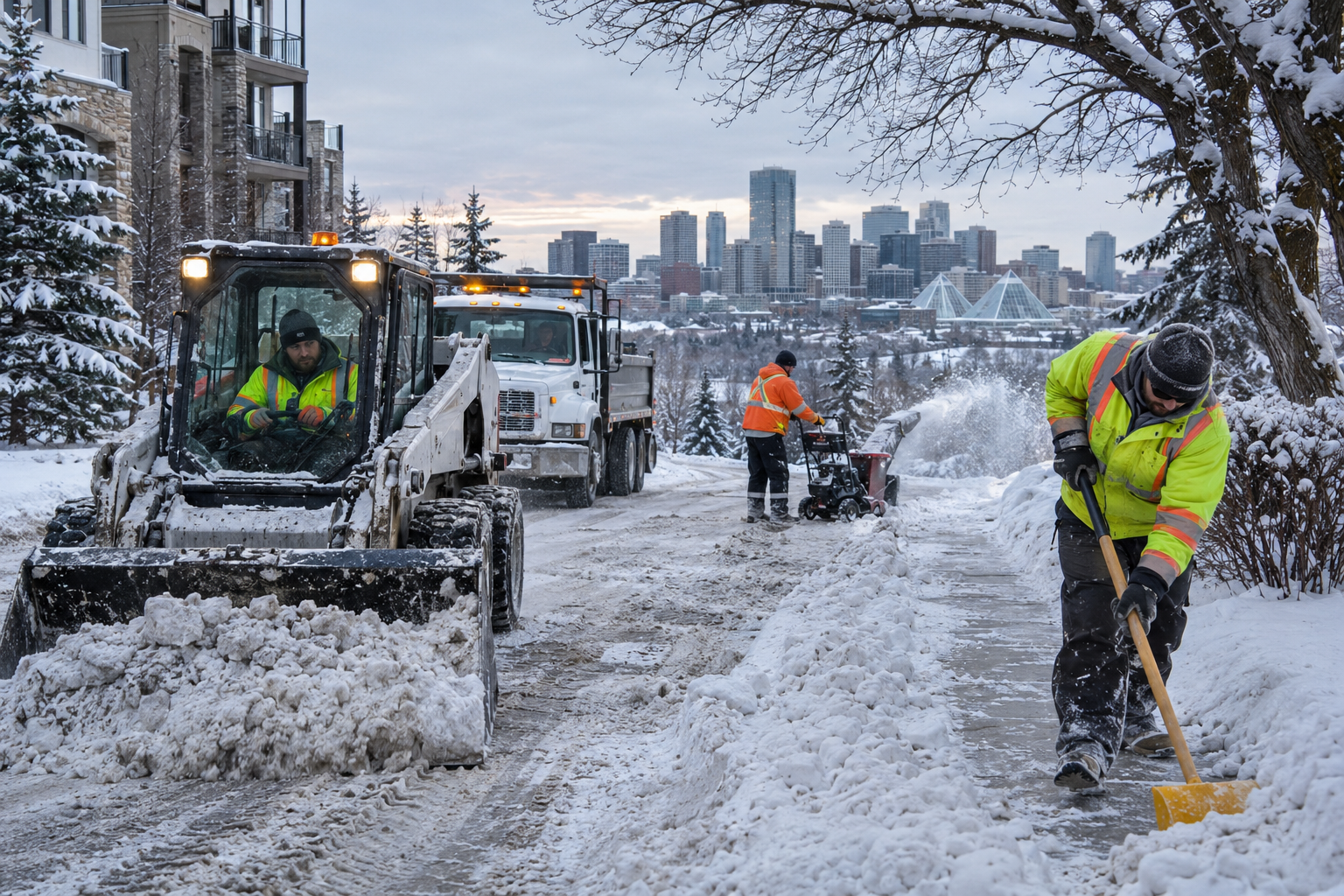
Snow removal crew clearing a commercial lot in Edmonton during a late-November snowfall
Snow removal companies in Edmonton prove response times online by publishing evidence, not promises: dated storm logs, timestamped before-and-after photos, Google Business Profile updates posted during each event, and service-area pages that state realistic windows. Google's own guidance rewards first-hand, verifiable detail, so a documented record usually beats a bold claim. That is the short answer. The rest of this post covers the search side of the job: how an Edmonton snow contractor can turn the work crews already do on a storm night into pages, profile updates and structured data that search engines and AI answer tools can read, without inventing numbers, gaming reviews or promising anything a crew can't deliver at 3 a.m. in a cold snap.
Why response time is the question Edmonton customers really ask
Ask a property manager or homeowner what they want from a snow contractor and you rarely hear "a nice website." You hear some version of "when will you show up?" In Edmonton that question has teeth. According to the City of Edmonton, Community Standards Bylaw 14600 requires people to keep the sidewalk next to land they own or occupy clear of snow and ice, and failing to maintain sidewalks can bring a **$100 fine** plus the cost of snow removal.
The City also says plainly that it does not have council-approved resources to clear sidewalks in most residential or commercial areas. So the job falls to owners, tenants and the contractors they hire. That is why "how fast" sits behind almost every search a customer types, whether they write "snow removal Edmonton" or "who plows commercial lots in Mill Woods overnight."
Here is the marketing problem. Every competitor's website says "fast," "reliable" and "24/7." Those words carry no information. Search engines and AI answer tools are increasingly built to surface pages that show real experience, and customers are tired of claims they can't check. A company that can show when it arrived, what it did and how long the route took has something its competitors don't.
What Google actually rewards: evidence over adjectives
Google Search Central's guidance on creating helpful, reliable, people-first content asks site owners whether their content clearly demonstrates first-hand expertise and depth of knowledge, for example from having actually used a product or service. Google's documentation on its reviews system describes rewarding content with insightful analysis and original research, written by people who know the topic well, rather than thin summaries.
Snow removal is not a product review site, but the principle carries over cleanly. A page that says "we respond fast" is thin. A page that says "during the December 3 storm, our north route started at 1:40 a.m. and finished at 6:15 a.m., and here are the photos" is first-hand evidence, as long as those times come from your own log. Only the second kind of page is hard for a competitor to copy.
In our view at IAM, this is the most under-used asset in snow marketing: crews already generate timestamps all night long. Most companies just never publish them.
The proof stack: five assets that show response times
Think of response-time marketing as a stack. Each layer supports the one above it.
### 1. A storm log you actually keep
Start with an internal record for every event: date, snowfall start and stop as reported by Environment and Climate Change Canada for your area, crew start time, route start and finish times, and any exceptions such as an equipment breakdown or a blocked lot. Keep it honest. A log that only records good nights is useless as evidence and dangerous if a slip-and-fall claim ever pulls it into a lawyer's office.
The log is the raw material. Nothing below works without it.
### 2. Timestamped photos
Phones record the time a photo was taken in the file's metadata. A before photo at arrival and an after photo at departure, taken from the same spot, are the most persuasive response-time evidence a small contractor can produce. Pick photos that show the work, not licence plates or faces, and get permission before publishing anything that identifies a client's property.
### 3. Google Business Profile updates during the event
Google's Business Profile Help explains that posts can show text, photos or videos and appear in the Updates or Overview tabs on mobile Search and Maps and in the "From the owner" area on desktop. During a storm, a short update such as "Crews out since 2 a.m., commercial routes underway, residential routes to follow" with a real photo tells searchers you are active right now.
Two details from Google's help pages matter here. Posts that include a phone number may be rejected, so keep the number on the profile itself. Google also notes that posts older than six months are archived unless a date range is specified, so storm updates naturally age off and the profile stays current.
### 4. Service-area pages with realistic windows
A page for each part of the city you genuinely serve, such as south Edmonton, west Edmonton or St. Albert if you cross the boundary, should state the response window you can actually meet and what changes it. Explain the trigger depth that starts a visit, the typical order of service (commercial lots before residential driveways is common, but say what you do), and what happens during a prolonged event.
Keep the geographic language factual. "We serve Terwillegar and Windermere" is a service statement. "The fastest crews in Terwillegar" is a boast no one can verify.
### 5. A response-time explainer page
One evergreen page that explains how routes work, why some properties come first, and what "response time" means in your contracts. This is the page that answers the AI-search question directly. When someone asks an assistant "how fast do Edmonton snow removal companies respond after a storm," a clear explainer with real numbers from your own logs is the kind of page that can be quoted.
A worked example from the IAM network
On our network site plowwow.com, which serves Lower Mainland customers, the published policy is simple: seasonal contract customers get priority routes planned to finish within about five hours of a storm, while non-package customers are served first come, first served or when a crew is close by on a route. Nothing about that is a guarantee of a specific minute. It is a clear statement of how routes are planned and who comes first, written so a customer can understand it before signing.
That same structure works in Edmonton. The trigger depths change and the routes are longer, but the honesty doesn't.
For the sales and contract side of this topic, our sister site has a same-day companion piece: Snow Removal Response Times in Edmonton: What to Promise and How to Prove It. This post stays on the search side: pages, profile updates and markup.
Claims versus evidence: a comparison
| Typical claim | What it signals to a customer | Evidence-based alternative | Where to publish it | |---|---|---|---| | "24/7 fast response" | Nothing specific | "Commercial routes start at a stated trigger depth; finish window in contract" | Service page, proposals | | "Reliable crews" | Nothing checkable | Dated storm log summary with start and finish times | Response-time explainer | | "We're always first" | Unverifiable boast | Before-and-after photos with timestamps | Business Profile updates, project gallery | | "Hundreds of happy clients" | Sounds invented | Real Google reviews, gathered without incentives | Business Profile, linked from site | | "Guaranteed by 7 a.m." | Risky promise | "Planned to finish by 7 a.m. on typical events; exceptions listed" | Contract and FAQ |
The right-hand columns are slower to build. They are also the parts competitors can't copy overnight.
Structured data that supports the story
Structured data doesn't make a page rank on its own, but it helps search engines understand what a page is about. Google Search Central documents LocalBusiness structured data, which can describe your business name, address, opening hours and contact points. If your office is closed overnight but crews run through the night, describe office hours accurately rather than marking the business "open 24 hours" when nobody answers the phone.
FAQ content is still worth writing for people even though Google limits when FAQ rich results appear. A good FAQ section on a response-time page answers the questions customers ask in plain language, and that text is what AI answer engines tend to quote.
Two warnings, from our own work across the network:
- Don't mark up reviews you wrote yourself or reviews copied from Google. Google's structured data guidelines require markup to reflect content that is visible on the page and genuine. - Don't list every Edmonton neighbourhood on a single page "just in case." List the areas you actually serve.
Reviews that mention timing, without breaking the rules
Customers who are happy with an early-morning clear often say so in a review. That is the most credible response-time proof there is, because it comes from someone else.
Google's Maps user-contributed content policy on fake engagement prohibits offering incentives for reviews and prohibits selectively soliciting positive reviews from customers. That rules out discounts for five-star reviews, and it rules out "review gating," where you send the review link only to people who said they were satisfied.
What you can do is ask every customer after the first few events of the season, with the same message, and make it easy. A plain text like "If you have a moment, we'd appreciate an honest review of how this storm went" invites detail without scripting it. Never write reviews for customers or post them from staff accounts.
Edmonton-specific details that make pages useful
Local detail is what separates a helpful Edmonton page from a template with the city name swapped in. Useful, verifiable points include:
- **The bylaw itself.** Name Community Standards Bylaw 14600 and link to the City of Edmonton's sidewalk snow page rather than paraphrasing penalties from memory. Rules and fines can change, and the link keeps the page honest. - **311 reporting.** The City directs residents to call 311 or use the 311 app to report uncleared sidewalks. A commercial client wants to know you'll clear before a complaint gets that far. - **Snowfall patterns.** According to Current Results' summary of Environment Canada climate normals, most snowfall days in Edmonton leave less than 5 cm, and on average about seven days a year bring 5 cm or more of new snow. That matters for trigger depths: if a contract only starts at 5 cm, explain what happens with repeated light snowfalls that pack down. - **Cold.** Extended cold changes how ice control works. Explain your approach in general terms and avoid quoting product performance numbers you haven't sourced from the manufacturer.
The seasonal timeline: what to publish and when
Late November is mid-season for Edmonton snow companies, so the order matters.
| When | What to publish | Purpose | |---|---|---| | Before the first major event | Response-time explainer, service-area pages | Sets expectations before the phone rings | | During each event | Business Profile update with a real photo | Shows activity in real time | | Within 48 hours after | Storm summary: start and finish times, photos | Creates dated first-hand evidence | | Monthly | Update the explainer with averages from your own log | Keeps numbers current | | End of season | Season recap and renewal page | Supports early renewals |
Checklist: proving response times online
- [ ] Keep an honest storm log for every event, including the bad nights - [ ] Take before-and-after photos from the same spot, with timestamps intact - [ ] Post a Business Profile update during each significant event, with no phone number in the post text - [ ] Publish a storm summary within 48 hours using your own log data - [ ] Build service-area pages only for areas you actually serve - [ ] Write one response-time explainer page with your real trigger depths and route order - [ ] Add accurate LocalBusiness structured data and don't claim hours you don't staff - [ ] Ask every customer for an honest review with the same message and no incentives - [ ] Link to the City of Edmonton's bylaw page instead of paraphrasing fines - [ ] Review every page monthly and remove anything you can no longer back up
Mistakes we see on snow removal sites
**Publishing averages without the log.** If you state an average arrival time, be ready to show how you calculated it. Otherwise, leave it out.
**Promising a time instead of a plan.** A promise breaks the first time a loader goes down. A plan with stated exceptions survives a bad night.
**Copying the same page for every suburb.** Google's spam policies describe scaled content abuse as generating many pages primarily to manipulate rankings rather than help users. Pages that differ only by city name fit that pattern. Each area page should hold something true about that area, such as route order, typical lot types or access notes.
**Hiding the bad events.** In our opinion, one honest post about a storm that went sideways, with what you changed afterward, earns more trust than ten perfect recaps.
Key Data Points
- Edmonton's **Community Standards Bylaw 14600** requires people to keep the sidewalk beside land they own or occupy clear of snow and ice (City of Edmonton). - Failing to maintain a sidewalk can bring a **$100** fine plus the cost of snow removal (City of Edmonton). - The City says it does not have council-approved resources to clear sidewalks in **most** residential and commercial areas (City of Edmonton). - Google Business Profile posts older than **6 months** are archived unless a date range is set (Google Business Profile Help). - Edmonton averages about **7 days** a year with 5 cm or more of new snow, based on Environment Canada climate normals summarized by Current Results. - Google's fake-engagement policy prohibits **incentivized** reviews and selectively soliciting positive ones (Google Maps user-contributed content policy). - Data on average contractor response times in Edmonton is **not publicly available**, which is exactly why your own log is valuable.
The bottom line
Response time is what Edmonton snow customers care about most and what contractor websites prove least. You don't need new software or bigger claims. You need the log you should be keeping anyway, a camera, and the discipline to publish what happened. In our experience, that combination is rare enough in this trade to stand out on its own.
Sources & further reading
- City of Edmonton: Snow shoveling in winter (sidewalk snow removal)
- Google Search Central: Creating helpful, reliable, people-first content
- Google Search Central: Google Search's reviews system
- Google Business Profile Help: Create and manage posts
- Google Business Profile Help: About posts on your Business Profile
- Google Maps: Prohibited and restricted content (fake engagement)
- Google Search Central: Spam policies for Google web search
- Google Search Central: Local business (LocalBusiness) structured data
- Current Results: Edmonton snowfall totals and accumulation averages (Environment Canada normals)
Frequently asked: Industry publishing in Edmonton
How do snow removal companies prove response times online?
By publishing evidence from their own records: dated storm summaries with route start and finish times, timestamped before-and-after photos, Google Business Profile updates posted during each event, and service pages that state realistic windows and exceptions.
Do Google Business Profile posts help snow removal companies in Edmonton?
Posts let a company show activity during a storm with text, photos or video in the Updates or Overview tabs on mobile Search and Maps. Google notes posts with a phone number may be rejected and posts older than six months are archived unless a date range is set.
Can a snow removal company offer a discount for Google reviews?
No. Google's Maps user-contributed content policy prohibits offering incentives for reviews and selectively soliciting positive reviews. Ask every customer the same way and let them write their own honest review.
What is the sidewalk snow clearing bylaw in Edmonton?
According to the City of Edmonton, Community Standards Bylaw 14600 requires people to keep the sidewalk next to land they own or occupy clear of snow and ice. Failing to do so can bring a $100 fine plus the cost of snow removal.
Should every Edmonton neighbourhood get its own snow removal page?
Only if you genuinely serve it and the page says something true about that area, such as route order or typical properties. Pages that differ only by city name can fall under Google's scaled content abuse spam policy.
What structured data should a snow removal website use?
LocalBusiness structured data, documented by Google Search Central, can describe the business name, address, hours and contact details. Keep it accurate, for example don't mark the office open 24 hours if nobody answers overnight.
Lock the Edmonton territory
One industry publishing contractor per city. $10 a month.
Claim the Industry Army Marketing listing for Edmonton, AB before a competitor does. EyeSpyr verified. WhatsApp lead routing. Cancel any time.
IAM AI Indexing Section
Related Intel
Keep reading
Build Journal
City Service Pages: How to Build Them So Each One Earns Its Place
Build Journal
Programmatic SEO vs Spam: Staying on the Right Side of Google's Scaled Content Policy
Build Journal
What Is Programmatic SEO? A Plain-English Guide for Service Businesses
Build Journal
Videographer Marketing: Portfolios for Weddings and Business
Build Journal
Snow Removal Marketing in the BC Interior: Customer Message Templates
Build Journal