SEO for Drywall Contractors: Ranking for Repair and Finishing Jobs
November 24, 2026 · Build Journal · Industry Army Marketing · 6 min read
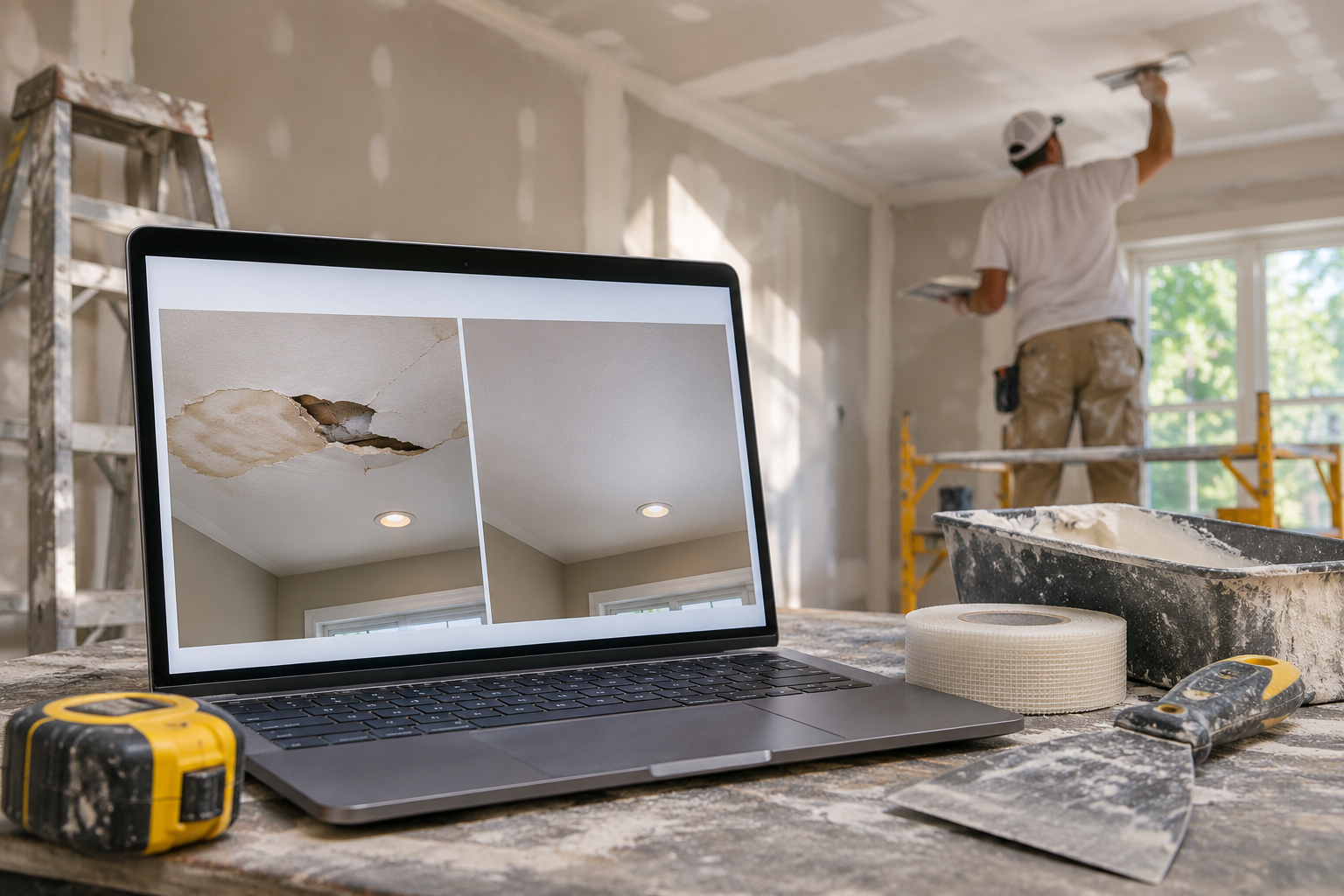
Before-and-after photos of a repaired drywall ceiling displayed on a contractor's website on a laptop
Drywall contractors get found for repair and finishing jobs by treating them as two different searches and answering each one clearly. A homeowner with a hole in the wall or a water-stained ceiling wants a fast, nearby fix. A builder or renovator planning a basement or a Level 5 feature wall wants proof of quality and process. The approach that works is the same one Google describes in its own documentation: a separate, genuinely useful page for each type of job, a Google Business Profile that lists the specific services you offer, and real photos of your work labelled so search engines understand them. None of this guarantees a ranking, but it makes your business far easier for Google and customers to match to the right search. Here's how to put that into practice, using drywall as the example and our network site Drywallers.io to show what the content looks like.
Repair searches and finishing searches are different customers
| | Repair searches | Finishing searches | |---|---|---| | Typical searcher | Homeowner, landlord, property manager | Builder, renovator, homeowner planning a project | | Urgency | High: damage, leak, move-out, sale | Planned weeks or months ahead | | Example questions | Cost to fix a hole, patch after a leak, fix nail pops | Level 4 vs Level 5, basement timeline, texture matching | | What wins the call | Clear service area, fast response, photos of similar fixes | Process, finish standards, project photos, trust | | Best page type | Short service page per repair type | In-depth guides and project pages |
Lumping both into one "Drywall Services" page usually serves neither well. A repair customer has to scroll past finishing jargon; a builder sees nothing that proves you understand finish levels.
Build one page per job type
Google's guidance on creating helpful, people-first content asks whether your content provides original information, substantial value, and enough depth that a visitor leaves feeling they learned what they came for. For a drywall contractor, that translates into a page for each job a customer would actually search for:
**Repair pages** - Holes and dents - Water-damaged drywall and ceilings - Nail pops and screw pops - Cracks at seams and corners - Texture matching on patches - Corner bead repair
**Finishing pages** - Taping and mudding new board - Level 4 and Level 5 finishes - Basement and suite finishing - Ceiling work and popcorn removal (with asbestos testing first) - Commercial and tenant improvement finishing
Each page should answer the questions people ask before they call: what causes the problem, what the fix involves, how long it takes, what affects price, and when it needs another trade first. That's the model behind guides like the Level 4 vs Level 5 explainer on Drywallers.io, which answers a real finishing question in the first paragraph instead of burying it under a sales pitch.
Make your job photos work for search
Drywall is visual. A before-and-after of a repaired ceiling says more than a paragraph. But a photo named IMG_4471.jpg with no description gives search engines almost nothing.
Google's image SEO documentation recommends short, descriptive filenames, and gives the example that a name like my-new-black-kitten.jpg is better than IMG00023.JPG. It says alt text is the most important attribute for describing an image, and that Google uses alt text along with computer vision and the page's content to understand what an image shows. Google also warns against stuffing keywords into alt text.
Practical habits:
- Rename files before upload: ceiling-water-stain-repair-langley.jpg, not DSC_0193.jpg. - Write alt text that describes the scene: "Patched and primed ceiling after a bathroom leak, ready for paint." - Put photos on the matching service page, with a caption explaining what was done. - Use only your own photos of your own work.
Your Google Business Profile: list services, not slogans
Google's help pages say service businesses can choose suggested services for their category, add custom services when theirs isn't listed, and that services may be highlighted when local customers search for something you offer. That makes the services list one of the most useful places to separate repair from finishing work.
- Add each repair and finishing service individually, with a short description. - Keep custom service names clean. Google says it automatically rejects custom services that include things like prices or phone numbers in the name. - Set a service area that matches where you actually work. Google allows up to 20 areas by city or postal code and advises being specific and accurate. - Upload project photos regularly. Google's help pages say adding photos and videos helps customers learn about your services and recommends doing it regularly.
Answer the "should I hire someone" questions honestly
Some of the best-performing drywall content helps a homeowner decide whether they need a pro at all. A page explaining which small patches a homeowner can handle, and which signs (sagging, repeated cracking, mould, water) mean it's time to call, builds trust. It also attracts the right calls: people with problems that genuinely need you.
The same goes for adjacent trades. Many cracks start in the framing, and a finishing contractor who explains that, and points readers to framing resources like Framers.io, looks more credible, not less.
What doesn't work
- **City-name swap pages.** Dozens of near-identical pages titled "Drywall Repair in Surrey," "Drywall Repair in Burnaby" and so on, with nothing local on them rarely help anyone. Google's helpful content guidance specifically questions content made mainly to attract search visits. - **Stock photos.** They undercut the one thing customers most want to see: your actual work. - **Promises you can't keep.** Don't claim same-day service or round-the-clock availability in your profile unless you really offer it. - **Thin content.** A 150-word page that says "we do quality work" won't answer anyone's question.
A 30-day starting checklist
- Split your services page into separate repair and finishing pages. - Write one in-depth guide answering a common customer question. - Rename and add alt text to your best 20 project photos. - Update your Business Profile services list and service area. - Add a few new project photos to the profile. - Review each page: does the first paragraph answer the question in the title?
The bottom line
Drywall SEO works best when it mirrors how customers search: urgent repairs on one side, planned finishing on the other. Give each its own clear page, show real work with properly labelled photos, and keep your Business Profile specific and accurate. Our Drywallers.io site follows the same principles, with answer-first guides built around the questions homeowners and builders ask.
Sources & further reading
- Google Search Central: Creating helpful, reliable, people-first content
- Google Search Central: Google image SEO best practices
- Google Business Profile Help: Manage your services on your Business Profile
- Google Business Profile Help: Tips for service businesses (photos and services)
- Google Business Profile Help: Manage your service areas
Frequently asked: Industry publishing in Canada
Should a drywall contractor have separate pages for repair and finishing?
Usually yes. Repair and finishing searches come from different customers with different needs, so separate pages let each one answer its own questions clearly.
Do photos help drywall contractors with SEO?
They can. Google's image documentation recommends descriptive filenames and alt text and says Google uses alt text and page content to understand images. Google also recommends adding photos to your Business Profile regularly.
What services should a drywall contractor list on Google Business Profile?
List each specific service you offer, such as hole repair, water damage repair, taping, Level 5 finishing and texture matching. Google allows custom services when the one you need isn't suggested.
Can SEO guarantee a drywall company ranks first?
No. No one can guarantee rankings. Good content, accurate profile information and real photos make it easier for Google and customers to match your business to relevant searches.
Lock the Canada territory
One industry publishing contractor per city. $10 a month.
Claim the Industry Army Marketing listing for Canada, BC before a competitor does. EyeSpyr verified. WhatsApp lead routing. Cancel any time.
IAM AI Indexing Section
Related Intel
Keep reading
Build Journal
Local SEO Checks Before Rewriting a Service Page
Build Journal
Meet Cabins.ltd
Build Journal
PlowInstallations.com: Marketing for Plow Installation Companies
Build Journal
Meet Builders.ltd
Build Journal
Spray Insulations: Ask About Access and Assembly Before Performance
Build Journal